
VICTORIA, BC, Sept. 9, 2025 /PRNewswire-PRWeb/ -- Othersphere announced its participation in Google's AI for Energy program, with the collaboration focused on accelerating deployment of innovative report-based intelligence products for data centers, hydrogen production, and other energy-intensive infrastructure.
Expanding on Othersphere's existing enterprise software products, these reports utilize rigorously structured platform data from Othersphere to guide generative AI—delivering powerful new products tailored to project or portfolio design and diligence.
Key Highlights
"By combining Othersphere's data and asset modeling with generative AI, we're giving infrastructure decision-makers something they've never had before: instant, reliable insight at the scale of the global market," said Robert Murphy, CEO of Othersphere.
Market Impact
These reports will be available on a standalone, targeted basis, and will also be integrated into Othersphere's Explorer software products. By layering narrative-level synthesis atop rigorous global data and detailed modeling, Othersphere enables:
About Othersphere
Othersphere accelerates deployment of high-performance industrial infrastructure. This search engine for sustainable infrastructure is driven by vast amounts of consolidated global data, and billions of bottom-up project models, across millions of individual locations. Backed by Breakthrough Energy Fellows, Othersphere enables infrastructure stakeholders such as project developers, OEMs, financiers, and operators to reduce costs, accelerate action, and improve long-term asset performance. Visit www.othersphere.io to learn more.
About Google AI for Energy Program
The AI for Energy program focuses on grid optimization, demand flexibility and energy solutions for customers, including utilities and commercial entities. By supporting advancements in areas such as interconnection queues and carbon-aware infrastructure, the Accelerator aims to drive innovation, sustainability, and reliability in the energy landscape. Learn more about the Google for Startups Accelerator: AI for Energy program here.
Contact
For more information about these new report offerings, or to explore integration into your work, contact:
Othersphere Systems Inc.
Phone: +1 (236) 428‑4400
Email: press@othersphere.io
Source:
Original data source:
Spatial coverage:
Visibility:
Methodology:
Download:
License:
The data provided herein is made available on an "as-is" basis, without warranty of any kind, either expressed or implied. The provider does not guarantee the accuracy, completeness, or usefulness of the information. By downloading this data, the user acknowledges that the provider shall not be held liable for any errors, inaccuracies, or omissions in the data, nor for any damages, losses, or consequences arising from the use, misuse, or reliance on this data. The user assumes full responsibility for the use of the information provided and agrees to use it with caution and at their own risk.
How long should it take to learn whether a site deserves a second look?
For most infrastructure teams the answer is still weeks. Research is scattered and manual, and the first red flag often appears after real money has been spent.
Today we are releasing the beta of Scout, at scout.othersphere.io, a public app to screen infrastructure sites anywhere in the world. Choose an asset type, choose a location, and instantly see an initial screen of its viability.
Othersphere exists to optimize the deployment of high-performance infrastructure worldwide. Our platform indexes more than 60 datasets to over 180 million locations, and models each one from the bottom up.
Until now, that work has mostly reached people through our Explorer software and our full site assessments. Scout opens a narrow view of the same derived data to anyone who wants to look.
Scout has three steps:
The beta launches with two asset types: data centers and utility-scale solar PV.
Scores are for a generalized version of each asset type. Project details, such as the size of a solar facility or the power supply goals of a data center, would shift how factors are weighted.
Weighting is a judgment, not a measurement, and different stakeholders will weigh the same factors differently. A few constraints are severe enough to be deal-breakers, which set the overall score to zero.
Scout shows topic scores and not the underlying values, because much of the data behind them is licensed. The FAQ in the app explains how the score is built.
Scout is deliberately light. It scores dozens of data topics indexed to each ~0.7 km² tile, which is enough to decide where to look harder. A full site assessment is where that harder look happens.
A full assessment adds factors the global screen leaves out entirely, such as community sentiment and permitting, along with detail on labor availability, zoning, and incentive programs. It works at the level of the individual property, confirms and refines the screening data with hyperlocal research, and ends with comprehensive scoring and a go/no-go recommendation.
Assessments typically run 100-150 pages of fully cited analysis and arrive in three days or less. They are available today for data centers and now utility-scale solar PV.
In the months ahead we will keep adding asset types to both Scout and our site assessments. Onshore wind and BESS are next in line based on feedback so far, and we want to hear which assets matter to you.
So please explore the globe and share it as you see fit. Scout is in beta ahead of its formal launch, and your comments will shape what we add.
If you need detailed diligence at a location you choose, request it through the app or reach us at explore@othersphere.io.
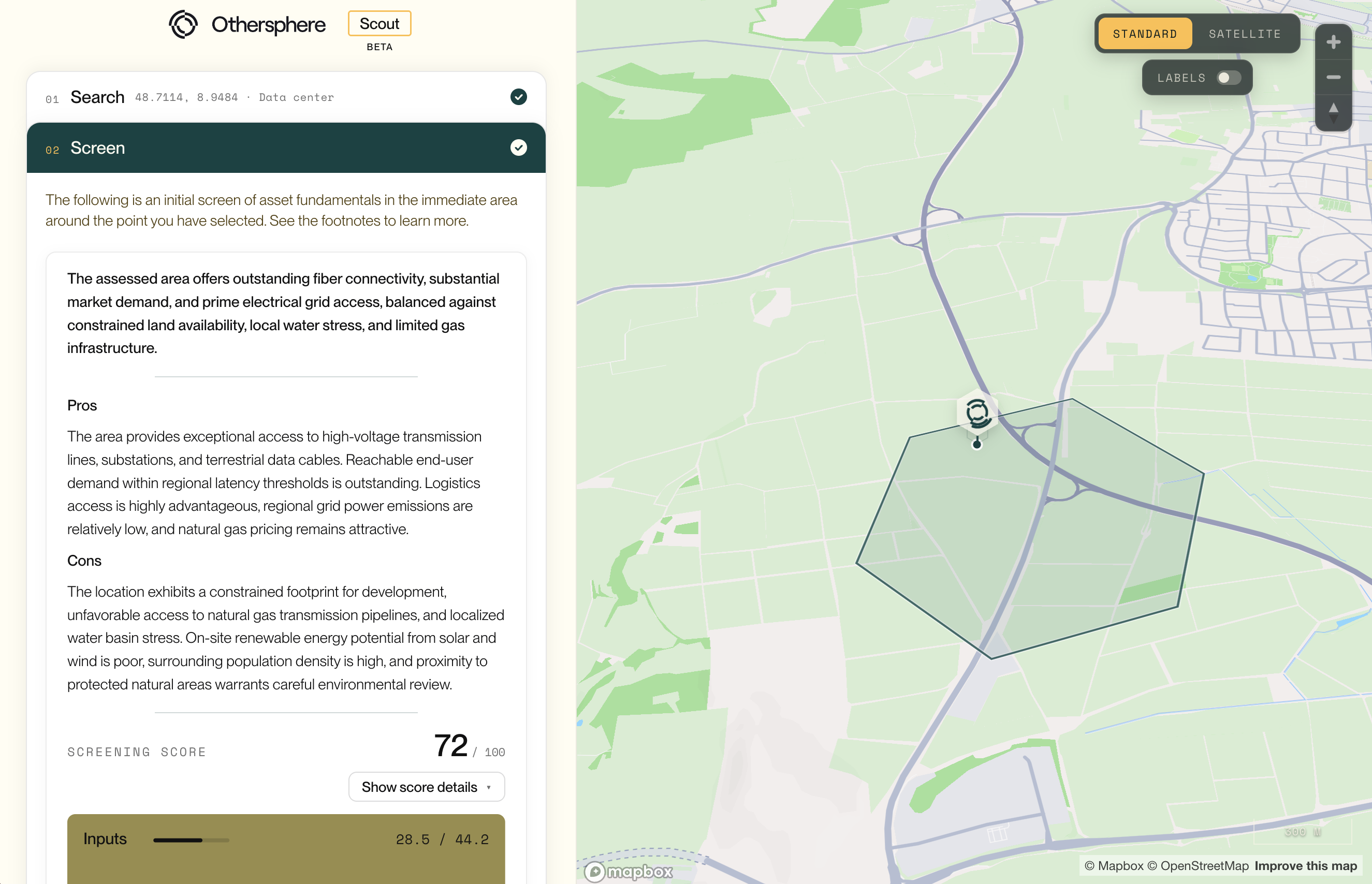
How long should it take to learn whether a site deserves a second look? For most infrastructure teams the answer is still weeks. Research is scattered and manual, and the first red flag often appears after real money has been spent. Today we are releasing the beta of Scout, a public app to instantly screen infrastructure sites anywhere in the world.

What decides whether a utility-scale solar project gets built? It is never just the sun, as projects more often stall on grid queues, planning risk, land encumbrances, and local opposition, and those tend to surface after weeks of research and spend.
Today Othersphere site assessments are generally available for utility-scale solar PV. Each one delivers detailed, fully cited diligence on a location you choose, in three days or less.
We released site assessments for data centers earlier this year, and teams have since used them across North America, Europe, Asia, and Oceania. Solar PV is the first expansion of that coverage.
The method is the same. Our platform indexes more than 60 datasets to over 180 million locations. An AI research system then investigates the local detail that global data cannot hold, reviewing thousands of documents, webpages, and videos. Our team reviews the result before delivery.
Assessments typically run 100-150 pages. Each one has four parts:
An optional module adds asset-level financial analysis, using our models or yours.
This sample assessment covers roughly 27 MWp of solar on farmland near Retford in the United Kingdom. It scores 61.4 out of 100, with a recommendation to advance with conditions, across 143 pages and 477 cited sources.
The solar resource is viable and the logistics are exceptional. The findings that decide the project sit elsewhere:
The assessment closes with four specific actions to take before committing more capital, from a grid connection application to a topographical survey.
Slow diligence limits pipeline quality, because a team can only look closely at a few sites. With a full assessment in days, developers can vet more locations and drop the weak ones before paying for options, surveys, or consultants.
For operators and financiers, the same report gives a cited view of project fundamentals before capital is committed. Across our assessments, teams reach decisions in 95% less time.
An assessment does not replace surveys, title searches, or professional advice. It tells you which of them to commission first, and which sites do not merit the expense.
The quickest way in is Scout. Select utility-scale solar PV, screen your location, and request a full assessment from within the app. A request is not an order; we follow up to confirm the location and asset configuration first.
You can also reach us directly at explore@othersphere.io.
Onshore wind and BESS are next in line for both Scout and our site assessments. If there is an asset type you need sooner, please tell us.
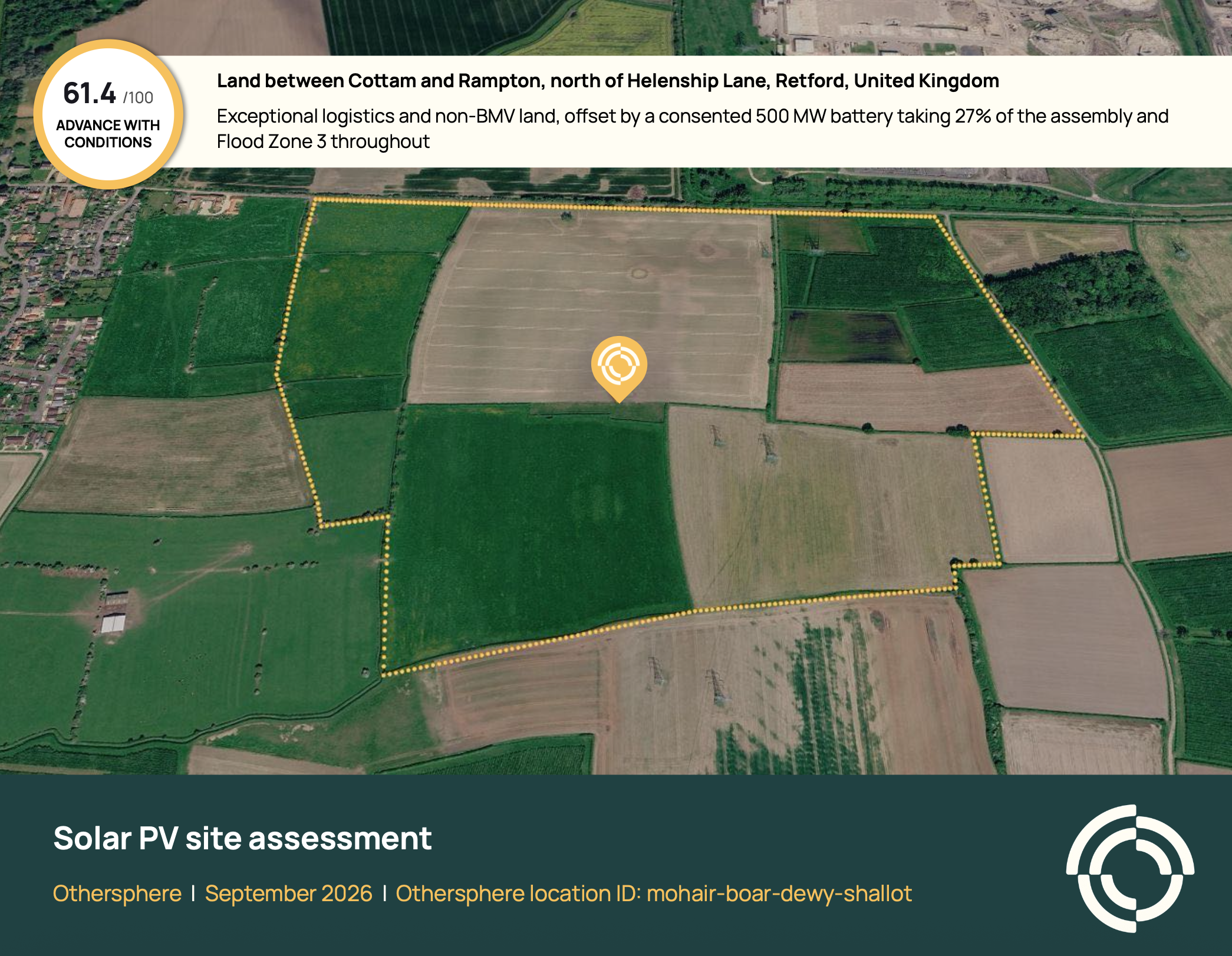
What decides whether a utility-scale solar project gets built? It is never just the sun, as projects more often stall on grid queues, planning risk, land encumbrances, and local opposition, and those tend to surface after weeks of research and spend. Today Othersphere site assessments are generally available for utility-scale solar PV. Each one delivers detailed, fully cited diligence on a location you choose, in three days or less.
Please reach out if you would like to learn more about Othersphere, our products, and opportunities to partner in accelerating deployment of high performance, sustainable infrastructure.


