
We are excited to share more about our work to maximize its reach and beneficial impact. This includes posts that highlight our thinking, resources that explain what we are building, and sharing novel datasets that we think can benefit the work of others.
When assessing data center sites, there can be a balancing act between remote locations and those closer to population centers.
Remote locations can offer clear advantages, including more building space or possibly lower-cost energy. But for AI inference, colocation, and other traditional compute needs, being closer to population centers of end-users is critical.
For data centers, fiber infrastructure plays a central role in that equation. Though factors like access to energy, community sentiment, and the permitting environment are a critical part of site assessments,this infrastructure is only as valuable as the user base it can reach.
To support this decision-making, we recently added a new data layer to inform Othersphere’s data center diligence engine, and we’re excited to share more about this work (to say nothing of the pretty maps).
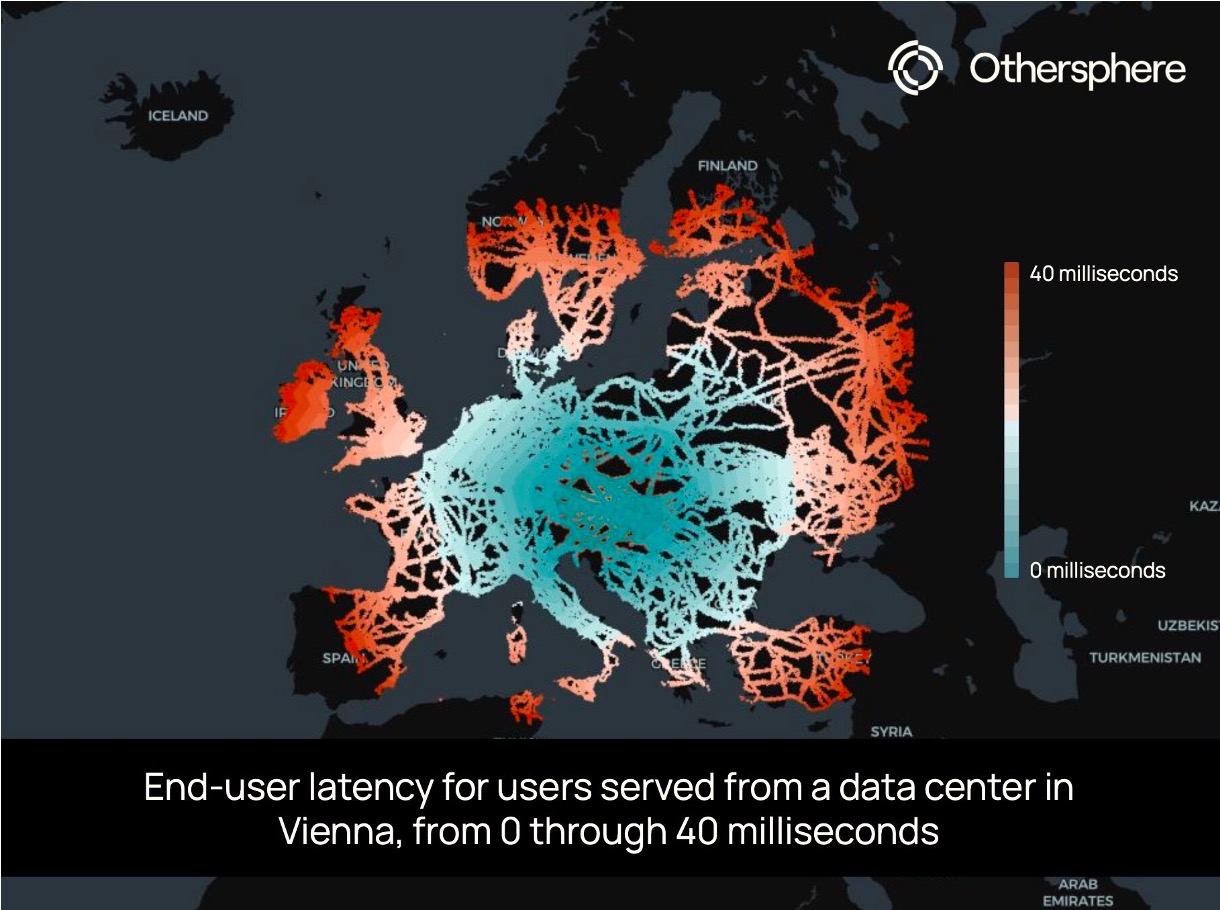
This new data layer provides an estimate of the population that can be reached from any location within certain latency thresholds. It adds an important dimension to site selection by helping clarify the tradeoffs between locations that may look attractive for different reasons.
This is made possible through our infrastructure analysis methodology, which indexes critical data to millions of locations and models the relationships within and between them. For this population estimate, the calculation begins by overlaying the world’s terrestrial and submarine fiber cable infrastructure on high-resolution population data. We then construct a weighted graph covering the entire globe, where adjacent tiles are connected by edges to calculate round-trip latency. As the signal moves from any user-selected location across on-fiber or off-fiber tiles, varying time penalties are applied. At a global scale, this requires simplifying assumptions on key questions such as available capacity, which we are able to investigate more deeply in each site-specific assessment.
This bottom-up estimate reveals stark geographic disparities. A well-connected tile in Europe (a randomly selected address in Vienna, in this case) can reach hundreds of millions of people within 40 ms, while a tile not far away in a telecom gap may only provide low-latency services to its immediate neighbors.
This data layer powers Othersphere’s understanding of where digital infrastructure creates (or fails to create) meaningful connectivity, and it is now threaded into all of our site assessments and scoring.
Reach out if you would like to learn more, or comment below if there are locations you’d like to see us post about.
When assessing data center sites, there can be a balancing act between remote locations and those closer to population centers.

Click here to access the Othersphere Data Center Atlas
What does the market view as a good data center location? This is something we can clearly observe based on how data centers are deployed today.
But how will the definition of a successful project evolve over time? And how might this differ across different classes of data centers?
Planning for the long-term, it is important that markets and policymakers are intentional about their expectations and requirements for these assets, as the role of data centers in economic growth, energy demand, climate outcomes, and geopolitical stability will all undoubtedly increase.
Then in the near-term, the risk of data center investment bubbles and market swings appear very high. As such, the ability to target data centers with strong fundamentals that will succeed in both good times and bad is essential.
History smiles on those who build commoditized industrial infrastructure in locations with the best fundamentals, so who will be the 'Saudi Arabia of compute'? The race to acquire power for these information refineries is the dominant narrative today. But when the smoke clears it will be key long-term fundamentals that matter to operators, policymakers, investors, communities, and beyond.
With this framing in mind, this Data Center Atlas is our contribution to inform a more data-driven view of the shape of the global data center fleet today, and how this may evolve over time.
At launch this Atlas includes a sample of the metrics we use to evaluate existing and potential data center locations. Here we highlight trends at the thousands of sites around the world that host data centers today, drawn from the over 180 million locations that Othersphere models worldwide. We are also experimenting with AI-generated/human-reviewed context for each metric; with AI model outputs shaped by the data provided from our backend.
This living document is also a pilot for future report-centric products on data centers and other industrial sectors, helping us understand needs around:
Reach out to learn more or provide feedback, and in the meantime, thanks for reading!
What does the market view as a good data center location? This is something we can clearly observe based on how data centers are deployed today.
VICTORIA, BC, Sept. 9, 2025 /PRNewswire-PRWeb/ -- Othersphere announced its participation in Google's AI for Energy program, with the collaboration focused on accelerating deployment of innovative report-based intelligence products for data centers, hydrogen production, and other energy-intensive infrastructure.
Expanding on Othersphere's existing enterprise software products, these reports utilize rigorously structured platform data from Othersphere to guide generative AI—delivering powerful new products tailored to project or portfolio design and diligence.
Key Highlights
"By combining Othersphere's data and asset modeling with generative AI, we're giving infrastructure decision-makers something they've never had before: instant, reliable insight at the scale of the global market," said Robert Murphy, CEO of Othersphere.
Market Impact
These reports will be available on a standalone, targeted basis, and will also be integrated into Othersphere's Explorer software products. By layering narrative-level synthesis atop rigorous global data and detailed modeling, Othersphere enables:
About Othersphere
Othersphere accelerates deployment of high-performance industrial infrastructure. This search engine for sustainable infrastructure is driven by vast amounts of consolidated global data, and billions of bottom-up project models, across millions of individual locations. Backed by Breakthrough Energy Fellows, Othersphere enables infrastructure stakeholders such as project developers, OEMs, financiers, and operators to reduce costs, accelerate action, and improve long-term asset performance. Visit www.othersphere.io to learn more.
About Google AI for Energy Program
The AI for Energy program focuses on grid optimization, demand flexibility and energy solutions for customers, including utilities and commercial entities. By supporting advancements in areas such as interconnection queues and carbon-aware infrastructure, the Accelerator aims to drive innovation, sustainability, and reliability in the energy landscape. Learn more about the Google for Startups Accelerator: AI for Energy program here.
Contact
For more information about these new report offerings, or to explore integration into your work, contact:
Othersphere Systems Inc.
Phone: +1 (236) 428‑4400
Email: press@othersphere.io

Othersphere announced its participation in Google's AI for Energy program, with the collaboration focused on accelerating deployment of innovative report-based intelligence products for data center, hydrogen production, and other energy-intensive infrastructure development.
Hi, I’m Jules Carney! As a front-end engineer at Othersphere, I’ve had the chance to work on features that would have felt impossible to bring to the web even a few years ago. We bring together detailed, accurate data from across the globe, and use it to paint a picture with graphs, maps and other visualizations. It brings insights on potential sites that tell meaningful stories for any audience. Needless to say, working on these features is a web developer’s dream come true!
Today I’ll walk through one of my favourite feature sets, because it imparts so much info about a potential site that users looking for a site could feel like they’re on the ground with their measuring tapes.
For a full video of the walkthrough below, please click here!
Let’s say a team wants to build a data center near Boulder, Colorado, but is worried about how the landscape will fit in with their building designs.
First, we’ll make a stop at the main map, where we can filter based on attributes we want the site to have, like average slope, land cost, distance to roads or power sources, and many other crucial factors. In the picture below, we’ve filtered to return sites with only 0-5% built area, and are colouring our heat map based on topography. Less populated areas tend to have steeper slopes, but with just this three second search we see some pale yellow hexes which are nice flat sites with few built-up areas. We could also do another search including our slope requirement filters if we wanted to just get back the hexes with lower slopes.

After we’ve picked a site, we can jump into site analysis. Looking at the left-hand tabs, we can see many ways to evaluate our location, including factors relating to economics, emissions, and fit with local human and environmental factors. These factors are then rolled into detailed project modeling, to bring the whole story together.
But let’s assume that the fundamentals look good, and so we want to move to the footprint tab as concern becomes fitting our data center to a given site.
First we check out a site, and we have a good sized potential footprint to work with, close to high voltage powerlines and data transmission cables.

Let’s assume we want to build a site about 1km square, so we check out an area with our Measure area tool.

It looks decent, and not built up, but let’s dig into the elevation and landscape a little more. We draw a line to measure the distance of our potential site, and we also get an elevation profile, which reveals a pretty significant variation of over 20 metres.

This area looks more promising! We see less variation in the elevation profile.

When we check out the area, it looks like there will be ample space here.

As a project developer I’d likely now loop back to iterate on the project model, using this area analysis and all of our other data to fine tune potential cost, emissions, and planning for aspects of local fit such as protected areas. From there I would likely review details on the land parcels and owners, to get ready for external engagement.
By bringing all of this together in one place, we can pick a great site with no surprises and everything we need for our data center to succeed!

Hi, I’m Jules Carney. a front-end engineer at Othersphere! Today I’ll walk through one of my favourite feature sets, because it imparts so much info about a potential site that users looking for a site could feel like they’re on the ground with their measuring tapes.
Markets are currently fixated on energy access as the near-term bottleneck for data centers... but strong underlying fundamentals are still the key to long-term asset performance.
Water access is one of those fundamental factors, and this MIT Technology Review article on data centers and water constraints in Nevada is well worth a read.
Elements that caught my eye:
- Direct cooling demand could reach 0.9–5.7 billion gal / yr and electricity generation could indirectly add ~15 billion, but actual figures general remain proprietary
- Tribal and local experts are working to highlight the risks of additional pressure on local systems
- Closed‑loop, water‑free air and immersion cooling could lead to meaningful demand reductionsHow does the rest of the world stack up?
Our Othersphere platform includes over 10,000 existing data centers, with World Resources Institute Aqueduct 4.0 basin‑level water stress (0‑5 scale) included as one search attribute.
Today nearly 15 % of data centers operate in the most water stressed locations (4.75 to 5), and the general distribution of data centers implies that water hasn't really mattered to siting... at least to date.
But that may be changing as:
1️⃣ Leading operators raise the bar
2️⃣ Public scrutiny climbs
3️⃣ Cooling tech continues to improve
Reach out if you want to learn more, or see how your site or company portfolio fits in into all of this.

Markets are currently fixated on energy access as the near-term bottleneck for data centers... but strong underlying fundamentals are still the key to long-term asset performance.
OpenAI is looking for new sites around the world for the next Stargate facilities. Is your jurisdiction a good fit?
The ability to rapid search the globe for ideal infrastructure locations based on the characteristics of a site or asset is just one of the user powers made possible by the Othersphere platform.
See here for a short video walkthrough of the Stargate 1 site in our Explorer tool.
In this quick example we instantly find the locations that are a close match with the initial Stargate 1 site in Abilene, Texas—characterized by excellent access to critical infrastructure, low power and gas prices, and a business-friendly operating environment, relative to middle-of-the-pack metrics on factors such as regional water scarcity, grid carbon intensity, and proximity to end users.
But is this the only type of location that can serve the future of AI? Absolutely not.
Are there locations that are even better than Stargate 1? Absolutely, especially as ‘better’ is all in the eye of the beholder.
Each developer, operator, utility, and government will take a different approach to building out the future of compute, and our global search engine for infrastructure enables you to test your own strategies quickly and efficiently.
Want to understand if you have a location that Stargate 1 stakeholders such as OpenAI, Crusoe, Oracle, Microsoft, Blue Owl Capital, J.P. Morgan, SoftBank, MGX, Newmark, or Primary Digital Infrastructure may be interested in?
Want to understand the types of locations that might be appealing to others?
Want to blaze a new trail entirely?
If you want to move fast but not break things, reach out to learn more.

OpenAI is looking for new sites around the world for the next Stargate facilities. Is your jurisdiction a good fit? The ability to rapid search the globe for ideal infrastructure locations based on the characteristics of a site or asset is just one of the user powers made possible by the Othersphere platform.
Please reach out if you would like to learn more about Othersphere, our products, and opportunities to partner in accelerating deployment of high performance, sustainable infrastructure.


